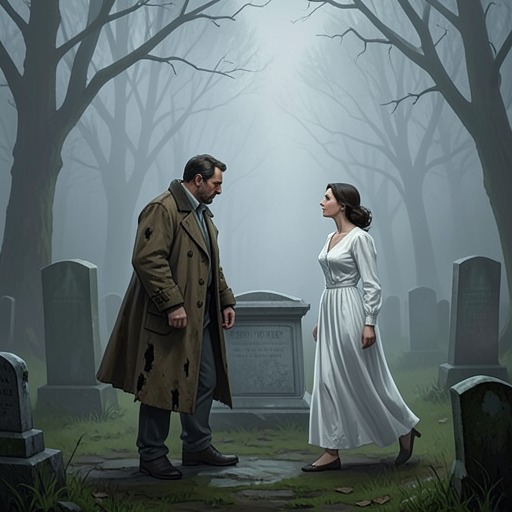
The people we love are always with us.
The Pale Blue EyeThe people we love are always with us is both a statement of comfort and a point of disagreement in Augustus Landor’s story. Patsy uses it to describe her daily connection with her dead mother, but Landor cannot accept its implication when he is confronted with his own bereavement. As the narrative develops, the expression reaches beyond private consolation: memory, keepsakes, dreams, and the telling of the past repeatedly bring the absent into the present, without settling whether this presence is supernatural or inward.
A phrase spoken between belief and refusal
Patsy offers the expression while speaking with Landor in the kitchen. She says that she talks to her mother every day, more often than when her mother was alive, and that sometimes her mother answers when Patsy needs her to. The account is presented as part of Patsy’s ordinary experience, not as a claim she is trying to prove. Landor responds with distress and moves about the room to warm himself. His reaction makes the phrase more than a general maxim: it meets a grief he cannot comfortably discuss.
Patsy insists that Landor knows better than to deny the continued presence of the dead. He answers that no one else is there and that they are alone. The exchange leaves its central difference intact. Patsy treats continuing connection as real and sustaining; Landor’s words insist on absence, even as his response reveals how charged the subject is for him. The expression comforts one speaker and exposes the other’s difficulty in receiving comfort.
Grief in the habits of the living
Landor’s account of sharing a bed gives that difficulty a concrete form. He recalls that he never grew used to another person’s presence there, yet, years after his wife Amelia died, he cannot grow used to having the bed to himself. He still lies on one side and tries not to use too much blanket. His habits preserve the shape of a shared life even where the person who shared it is gone. When Patsy clarifies that she was not speaking of Amelia, Landor says that Amelia, too, is gone. The brief exchange distinguishes Patsy’s active sense of connection from Landor’s insistence on loss, while showing that absence has not erased the routines formed in a relationship.
The expression is not offered as a cure for grief or as proof that the dead return. Instead, the scene places two ways of living with loss beside each other. Patsy can speak to her mother as an ongoing relationship; Landor describes the residue of marriage through the limits he places on his own use of the bed. His resistance does not make the past inert. The small, repeated behavior of lying on one side reveals a continuing attachment that his spoken denial cannot simply remove.
Objects and dreams as returns
The idea of continued presence also appears in Landor’s dream of Leroy Fry. In the dream, Fry is no longer dressed as a cadet but wears officer blue; he carries charcoal and a cage of blue-eyed birds, and the birds’ repeated words are joined by a woman singing. Landor wakes with the dream still vivid to him, then calls it a fancy and connects it to the difficulty of sleeping. His qualification matters: the scene gives the dead a voice within his experience, but his own narration does not establish that the dream is a supernatural message. It registers instead how investigation, memory, and disturbed sleep can blur the boundary between waking thought and what returns in dreams.
A different kind of return follows the death of the unnamed maiden in Landor’s story about a father and daughter. The father discovers in a volume of Byron’s poetry a chain she had kept after returning from a ball. The object links her concealed experience to the father’s later understanding: he wonders whether she meant him to find it and use it. The chain carries a past event into a new moment and gives the living father something to interpret. Here, the bond does not take the form of conversation. It persists through an object, its placement among cherished pages, and the meaning the bereaved person makes from finding it.
Time folded around the absent
Near the end, Landor describes a changed understanding of time in which the living and the dead are not cleanly separated. In his imagined company, figures from different periods occupy the same ground and continue the ordinary business they had in life. He pictures Lea studying with Henri le Clerc and Edgar Allan Poe writing verses with Mattie Landor; his other remembered visitors likewise remain engaged in familiar activities. These are Landor’s reflections, not an independently confirmed account of an afterlife. Their importance lies in how they give form to the same continuity Patsy had expressed in personal terms.
The closing thought that Mattie might also be among these companions makes this imagined company bear directly on Landor’s own expectation of death. He says that the possibility makes the end easier to think about. The expression’s reach has therefore changed: it began as Patsy’s confidence about speaking with her mother, but Landor’s final reflection gives him a way to imagine those he has lost as still connected to his life. This is not a simple conversion to Patsy’s belief. Rather, the narrative moves from his explicit denial of anyone’s presence toward an image of time in which the dead remain part of the living world as remembered, narrated, and loved.
Narrative function
The expression gathers several different forms of attachment without making them equivalent. Patsy describes reciprocal conversation; Landor’s habits preserve the outline of his marriage; a dream brings Fry into a disturbed night; the chain links a daughter’s hidden past to her father’s later actions; and the final meditation makes remembered people companions across generations. Each form has its own limits, and the narration leaves those limits visible. It neither proves that the dead literally speak nor reduces every encounter to an empty figure of speech.
That uncertainty gives the expression its weight. It can be a source of comfort, a challenge to someone who is not ready to accept comfort, or a structure through which the story presents grief and remembrance. Landor’s changing language and final image do not cancel his losses. They show instead that the absent continue to shape the living person’s routines, interpretations, memories, and sense of what may come after life.